Spanish (Castilian), one of Spain's languages
Taste, say and celebrate Spain, then earn the Spain stamp in World Explorer 2.
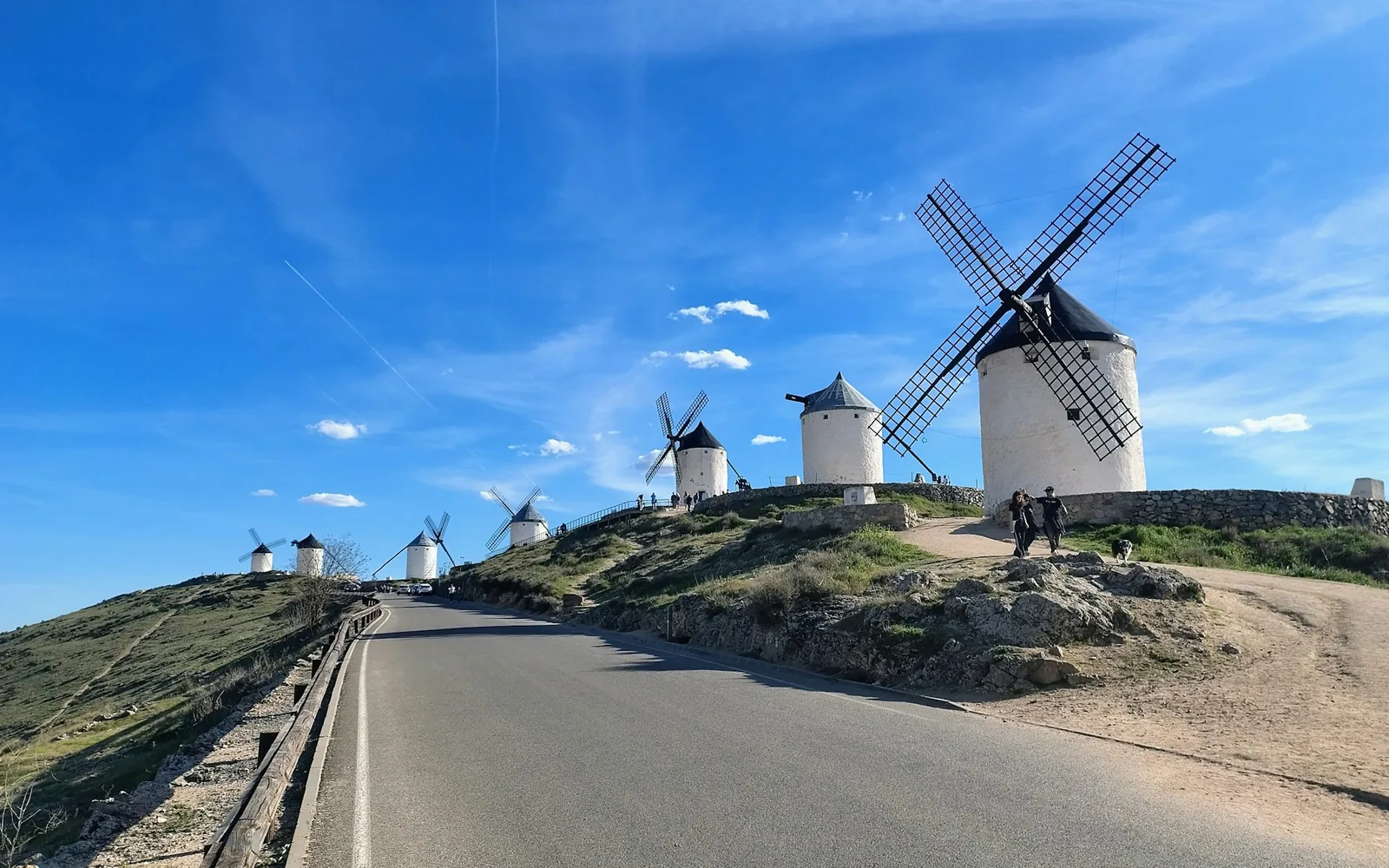
Windmills at Consuegra, Spain · Photo: Sergio Guardiola Herrador / Unsplash
Official name
Kingdom of Spain (Reino de España)
Capital
Madrid
Official language(s)
Spanish (Castilian) nationally; Catalan, Galician, Basque and Aranese are co-official in their regions
Currency
Euro (EUR)
Common greeting
Hola; Buenos días
Calling code
+34
Time zone(s)
Mainland: CET (UTC+1), CEST (UTC+2) in summer; Canary Islands: WET (UTC+0), WEST (UTC+1) in summer
Sources: Spain – Wikipedia, Time in Spain – Wikipedia, List of country calling codes – Wikipedia, ISO 4217 currency codes – SIX Group, La Moncloa – Government of Spain
Spain has about 48 million people in 17 autonomous communities, and the regions have strong identities. Spanish, also called Castilian, is the official language, with Catalan, Galician, Basque and Aranese co-official in their territories, and Valencian recognised as a form of Catalan. Andalusia, Catalonia, the Basque Country, Galicia, Madrid and the islands each have their own food, music and festivals, and communities from Latin America, Morocco, Romania and many other countries are part of everyday life.
Friends and acquaintances greet each other with two kisses, one on each cheek, between women and between a man and a woman, while men often shake hands or hug; in business a handshake is standard. “Hola”, “buenos días” and “buenas tardes” are common, and “¿qué tal?” is a greeting rather than a question. Spaniards often switch quickly to the informal “tú”, although “usted” is used with older people and in formal contexts.
People may speak at a lively volume and stand fairly close; this is warmth, not aggression. In regions with their own language, such as Catalonia or Galicia, greeting in the local language is appreciated.
Meals and conversation are central to social life, and time is often flexible: if you are invited for 9 p.m. to a house, arriving ten to twenty minutes later is normal, while for work you should be on time. Shops in smaller towns may close for a long midday break, and Sunday opening is limited. Dress is smart and relaxed, and appearance matters.
Hosts appreciate a small gift such as wine, sweets or flowers, and refusing food or drink more than once may disappoint them. Avoid joking about regional independence movements, bullfighting or the monarchy, which can be sensitive, and do not assume Spain is the same as Mexico or Argentina. Tipping is modest, often rounding up or leaving small change.
Lunch is the main meal, usually between two and four, and dinner starts at nine or later. Typical dishes vary by region: paella in Valencia, gazpacho and fried fish in Andalusia, pintxos in the Basque Country, fabada in Asturias, pulpo a la gallega in Galicia and cocido in Madrid. The tortilla española, a potato omelette, jamón ibérico and olive oil appear everywhere, and the Mediterranean diet is recognised by UNESCO.
Tapas, small dishes, are shared at bars, and it is normal to move from bar to bar. Bread is on the table, and the bill is not brought until you ask for “la cuenta”. Sobremesa, the time spent chatting after a meal, is as valuable as the meal itself. Many restaurants offer a set weekday lunch, the “menú del día”. Vegetarian options are more common in cities, and it helps to explain dietary needs clearly.
Día de Reyes on 6 January celebrates the Three Kings, with parades the evening before, gifts on the morning of the day and a ring-shaped cake, the roscón. Semana Santa, Holy Week, brings solemn processions with floats, pasos, and penitents in robes, especially in Seville, Málaga, Valladolid and Zamora.
Other well-known events include Las Fallas in Valencia, San Fermín in Pamplona, La Tomatina, local fiestas patronales, Christmas Eve and New Year’s Eve, when twelve grapes are eaten at midnight.
Spanish weddings are often late-evening celebrations with a meal and dancing until dawn. Our guest’s guide to a Spanish wedding explains dress, gifts and the schedule.
Spanish workplaces value personal relationships. Expect friendly small talk before business, and meetings that may start a few minutes late and overrun. Communication is often warm and direct, and disagreements are discussed openly, without hurting the relationship. Hierarchy is respected, but first names are common among colleagues, and email follow-ups are appreciated.
Spain uses Central European Time with daylight saving, except the Canary Islands, which are one hour behind. The working day often has a long lunch break and ends later than in northern Europe, though many companies have moved to a more continuous schedule. August is the main holiday month, and offices can be quiet. Public holidays vary by region, so check the calendar for the city. Colleagues from different regions may prefer to speak their own language socially, which is not meant to exclude you.
Two, starting with the right cheek, between friends and acquaintances, including in many first meetings. In formal business, a handshake is safer.
Lunch is a late, large meal, and the working day ends later, so dinner usually starts around nine or ten in the evening.
Yes, they are two names for the same language. Other languages such as Catalan, Galician and Basque are co-official in their regions.
World Explorer
Families who want to explore Spain through short games can try the Culture XI World Explorer app.