Polish
Taste, say and celebrate Poland, then earn the Poland stamp in World Explorer.
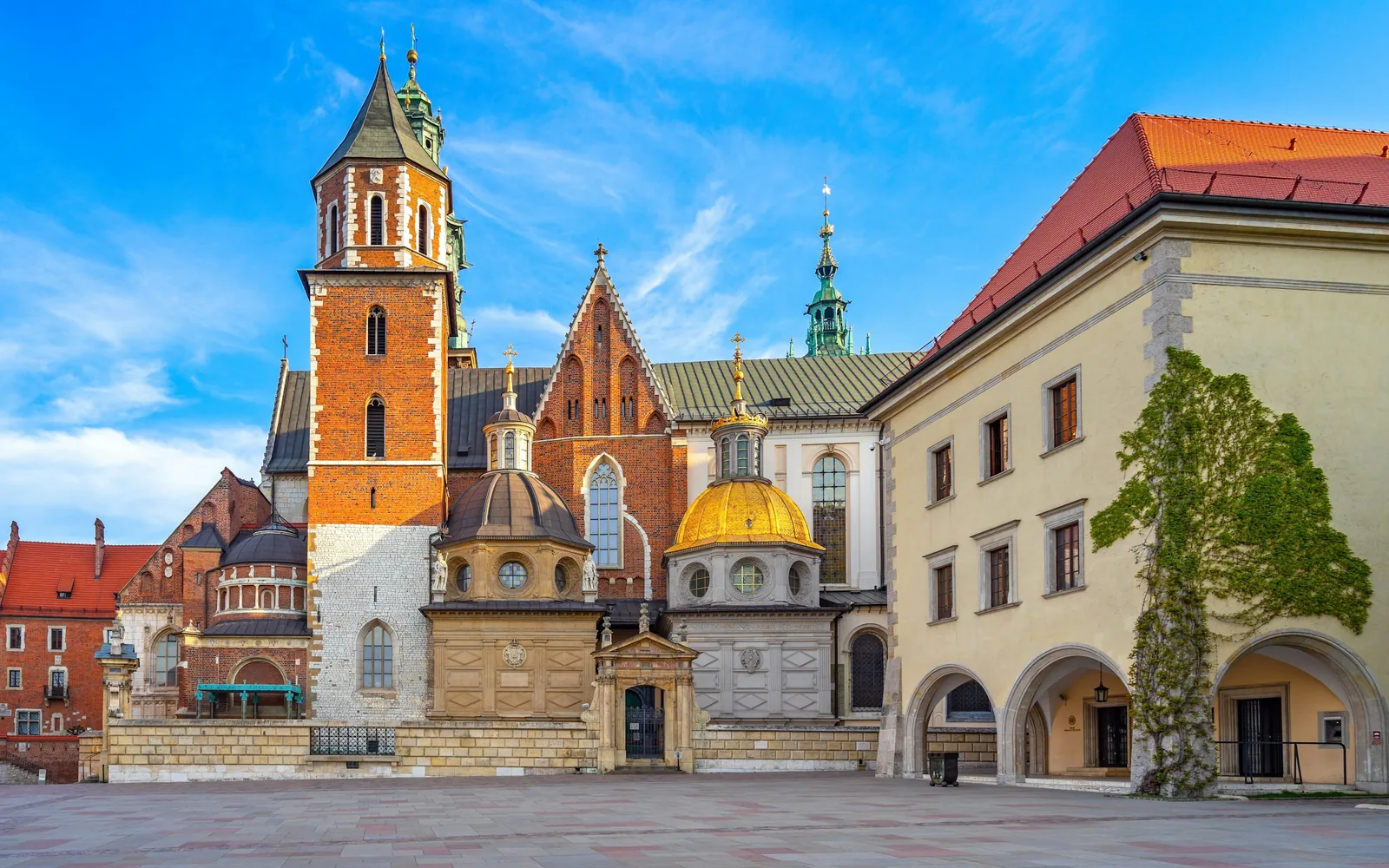
Wawel Castle, Kraków, Poland · Photo: Wojciech Wyszkowski / Unsplash
Official name
Republic of Poland (Rzeczpospolita Polska)
Capital
Warsaw (Warszawa)
Official language(s)
Polish
Currency
Polish złoty (PLN)
Common greeting
Dzień dobry
Calling code
+48
Time zone(s)
CET (UTC+1), CEST (UTC+2) in summer
Sources: Poland – Wikipedia, Time in Poland – Wikipedia, List of country calling codes – Wikipedia, ISO 4217 currency codes – SIX Group, Official website of the Government of Poland
Poland has about 38 million people and sixteen voivodeships, from the Baltic coast to the Tatra Mountains. Polish is the national language, and Kashubian is a recognised regional language, while German, Ukrainian, Belarusian, Lithuanian and Romani minorities live in different parts of the country. Most Poles are Catholic, and the Church shapes the calendar, though traditions vary from big cities to villages. Regions such as Silesia, Kashubia, Podhale and Masuria have their own dialects, costumes and food.
A firm handshake with eye contact is the usual greeting; men often wait for a woman to offer her hand. Say “dzień dobry” during the day and “dobry wieczór” in the evening, with “cześć” among friends. Address people as Pan, Mr, or Pani, Mrs or Ms, with a title or the first name, such as Pani Anna, and wait to be invited to use the informal “ty”, which is often proposed with a toast.
Name days, imieniny, celebrated on the day of the saint whose name a person carries, are as important as birthdays for many Poles; a small card, flowers or good wishes are welcome.
Hospitality is generous. Hosts offer food and drink repeatedly, and refusing once politely is expected before accepting. In many homes you take off your shoes and are offered slippers, kapcie. Bring flowers in an odd number, a bottle of wine or sweets, and avoid chrysanthemums, which are linked to cemeteries, and even numbers, reserved for funerals.
Formality matters in the early stage of a relationship, and keep your voice at a moderate volume in public. Alcohol is common at celebrations but never obligatory, and it is fine to decline politely with “dziękuję, nie piję”. Many shops are closed on Sundays under trading restrictions, so shop in advance. Tipping of about ten percent is customary in restaurants.
Polish food is hearty. Pierogi, filled dumplings, come with cheese, potato, cabbage and mushrooms or meat, and bigos is a stew of cabbage and meats. Żurek is a sour rye soup, barszcz is beetroot soup, gołąbki are stuffed cabbage rolls and kotlet schabowy is a breaded pork cutlet. In the Tatras, oscypek, a smoked sheep’s cheese, is a speciality, and the coast offers fish.
Lunch, obiad, is the main meal, usually in mid-afternoon and often starting with soup. Desserts include sernik, cheesecake, makowiec, poppy-seed roll, and pączki, doughnuts eaten on Fat Thursday. Say “smacznego”, enjoy your meal, before eating and “na zdrowie” when toasting. Hosts are happy to prepare vegetarian food on request, though meat is frequent in traditional cooking.
Wigilia, Christmas Eve on 24 December, begins when the first star appears, with a meatless supper, the sharing of opłatek, a thin wafer, and an empty place at the table for an unexpected guest. Wszystkich Świętych, All Saints’ Day on 1 November, sees families travel to cemeteries to light candles, znicze, at the graves of relatives.
Easter brings the blessing of food baskets on Holy Saturday and Śmigus-dyngus on Easter Monday, while 3 May and 11 November celebrate the Constitution and Independence.
Polish weddings are long and generous, with a church ceremony, a banquet and dancing. Our guest’s guide to a Polish wedding explains gifts, the bread and salt welcome and the evening.
Polish workplaces tend to be formal at first. Use titles and surnames until invited otherwise, shake hands on meeting, and respond to emails promptly. Colleagues are often well trained and take pride in their work, and many people in business speak English, German or other languages. Hierarchy matters in many companies, while technology firms and start-ups tend to be less formal.
Poland uses Central European Time with daylight saving. Be on time for meetings, and note that people often work long hours but also value family time; lunch is a real break. Public holidays such as 15 August, 1 November and 25 and 26 December close shops and offices. Remember name days, as a small gesture, such as bringing cake, is a friendly way to build relationships, and do not assume that all colleagues are religious.
Pan is Mr or sir, and Pani is Mrs or madam. They are used with a title or first name in polite speech, such as Pani Anna.
The day dedicated to the saint whose name a person carries, celebrated with wishes, flowers or a small treat, in some workplaces with cake.
Poland restricts Sunday trading, so most shops are closed except on a few Sundays a year, though petrol stations, bakeries and pharmacies are exceptions.
World Explorer
Families who want to explore Poland through short games can try the Culture XI World Explorer app.